

Combat Racism Using Cultural Strengths


Dr. Charity Brown Griffin is an Associate Professor at Winston-Salem State University, studying various factors influencing positive youth development in African American youth. She looks at how race-related experiences may impact how children see themselves and how others and society shape their behavior. Dr. Griffin spoke with us about instilling cultural, racial, and ethnic pride in children to help protect their mental health and well-being and drawing on those strengths for support and buffering if and when they deal with racism or racial trauma in their lives.
Eden Pontz: How can parents instill racial and cultural pride in their children? And how does it protect their mental health?
Dr. Charity Griffin: Parents can instill racial, cultural, and ethnic pride in their children through open, honest conversations. These conversations can look like telling your child about the history of your racial and cultural heritage, talking to them about the resilience and brilliance of your racial and ethnic group or cultural heritage. It can also include engaging in behaviors. So, in addition to having open and honest conversations, you can do things like take your child to a cultural history museum. Parents can also think about mentors and other caring adults beyond the family who can instill messages through direct conversations or behaviors.
EP: What are some coping strategies that parents or guardians can recommend to help their children if they experience racial trauma?
CG: The first coping strategy I recommend for caregivers to help their children if and when they experience racial trauma is to acknowledge that racism is wrong and can damage mental health. So, the feelings that you feel when bad things happen to you, those feelings are appropriate. It’s okay to feel angry, upset, sad, or frustrated. Don’t gloss over negative feelings that happen as a result of racism.
It’s important to encourage open and honest communication when trying to provide your child with coping strategies. You want to ensure you create a safe space for your child to express their feelings and experiences without judgment.
A primary coping strategy is to focus on cultural empowerment, which is fostering a strong sense of identity and pride within your culture. Help your child connect with their cultural heritage. That could include taking them to a museum, cooking certain dishes, and watching TV shows or reading news articles that positively represent your cultural heritage. Positive experiences related to one’s cultural identity create pride. They serve as positive affirmations about your background. Then, if you do experience racism or discrimination, you have this buffer where you know you should be proud of who you are – proud of your identity. And although you feel bad, upset, and angry this experience of racism happened, you know who you are as a person. This cultural empowerment can help a child bounce back and foster resilience.
Other coping skills that a caregiver can offer are things like mindfulness. Encourage the practice of deep breathing exercises and journaling. And after you have those open lines of communication and are processing the incident, it might take these practices to help manage your child’s stress and anxiety. Even things like art, music, or other forms of creative expression can be powerful for processing emotions. Encouraging your child to express themselves through these creative means can also be beneficial.
Lastly, teach your child advocacy skills. These can be an important coping mechanism, especially for teenagers who desire to be more independent and vocal. This is a prime time for parents or other trusted adults to encourage these advocacy skills and teach their children how to stand up for themselves.
As a caring adult, you can do things that involve advocacy skills, including getting involved at the community level. You may attend a school board meeting and talk about social justice issues or issues of racism.
EP: How does language affect tweens’ or teens’ ability to understand their experiences with discrimination? And what do you think parents should keep in mind when talking with them about those experiences?
CG: Language plays a crucial role in young peoples’ ability to understand and articulate their experiences with discrimination. Adolescence is a period when your child can think about things in an abstract or complex way. So, we want to draw on that skill by talking about more complicated topics while using age-appropriate language. When we think about the idea of racism, it’s important to consider what they already may know about racism and what racism means and then fill in the knowledge gaps. Understanding structural racism or institutional racism – those are broad, abstract concepts. But this is a perfect time for parents to explain the history of racism and its impact on the lives of BIPOC (Black, Indigenous, and People of Color) families and children today. Parents should make sure that they use clear terms related to race, ethnicity, and discrimination and make sure that their child understands the language used.
If your child has a challenging time understanding some of the more complex concepts you’re discussing with them, sharing personal experiences that you or other family members or extended kin have gone through can help them to understand what these experiences are like. Also create a safe space for you to talk about how you overcame these challenges. Show how you were resilient and what coping strategies you used to navigate racial trauma.
Finally, try to offer age-appropriate materials and resources. Books, articles, and documentaries are all resources that can be helpful for exploring the issues of discrimination. Think about choosing two to three books or documentaries that you read or watch together to help you process and understand racial trauma experiences. That way, you can also use the resources to help support your parenting with the vocabulary and explanations of different forms of racism and discrimination you and your child may experience.
EP: Explain the concept of racial socialization and how it’s used to help support teen mental health.
CG: Racial socialization is understood as the messages a caregiver communicates to their child about their race. It instills positive pride and emotions and helps prepare them for racial discrimination and racism experiences in society. Racial socialization plays a crucial role in shaping how our youth understand race and how they can cope or deal with racism in society. We have different types of racial socialization messages. Some are about fostering pride and empowering social and racial identity within the child. Parents can communicate these messages verbally by saying things like, “Black is beautiful, you should be proud to be Black,” or through their behaviors like taking your child to a museum of African American history and culture or watching television programming that spotlights the positive identity and cultural heritage of Black people. Research has revealed that if you bolster the self-esteem and pride in the cultural identity of Black youth, it can be protective and can help prevent some of the negative outcomes that might be associated with racism and discrimination.
Another type of racial socialization message is preparing your child for the bias that they may experience. Some parents may be uncomfortable talking about experiences of race and racism within society. But if you have open discussions, research shows discussions about what to do when you experience racism are tools you can use to cope so youth don’t experience as much racial trauma.
To use the strengths of BIPOC families to cope with mental health struggles, read more of our conversation here.
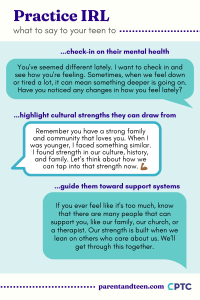
Save this graphic or pin it for later to practice these concepts IRL (in real life):
Also Read This
Related topics for helpful discussions.


