How to Help Motivate Your Teen


In this interview…
Is it possible to motivate your teen? The answer may surprise you.
Discover why rewards are not an effective method of motivation.
How to use visualization to help achieve goals and success.
Why to avoid telling your teen they are smart or talented to motivate them.
Dr. Wendy Grolnick, Professor of Psychology at Clark University, has studied motivation for almost 40 years. She consults with parents, teachers, students, and others and teaches about what motivates people. She says she believes that many people have misconceptions about motivation. Her observations led her to team up with Benjamin Heddy, PhD, and Frank Worrell, PhD, to co-author “Motivation Myth Busters,” a book that challenges common myths about motivation. Their goal? To reveal the up-to-date science and offer proven strategies for successfully motivating yourself and others. We sat down with Wendy to learn more about helping teens to increase their motivation.
EP: What is motivation?
WG: We define motivation as the energy you bring to things you do in tasks or situations. We want to have the motivation to do the things that will help us meet our goals, to get the things that are important to us done.
It’s important to have motivation. But the kind of motivation we have is also key. We can have different reasons for doing something. We can be doing it because someone else is pushing us, to get a reward, because we would feel bad or guilty about not doing it, or to reach a goal that’s important to us. Both the amount and the type of motivation make a difference in how much we get done, how we pursue tasks, and our well-being.
EP: Why does it seem that some people are more highly motivated and others are not?
WG: That’s one of the myths in our book – that some people are motivated and others aren’t. It’s the idea that motivation is a trait – some people have it, and some people don’t. Or some people have more than others. What the science reveals is that we’re all motivated. But it’s a question of what we’re motivated for and when we’re motivated to do things.
Where we put our energy is more a function of our interest in the area – for example, whether it’s school, or sports, or social media, and how other people treat us in that setting. What are the conditions for us? Motivation is about people’s interests and the situation they’re in much more than whether they’re a motivated person. Everyone is motivated.
EP: I like hearing that because it holds potential for everybody, even those who don’t think they are motivated. So, when it comes to motivation in teens, how should we, as parents or caring adults, help support our teens?
WG: Motives are internal. They lie within people. You can’t really motivate someone. You can get people to do things. For example, we can get our teens to clean their rooms or to study hard, but we can’t necessarily get them to be motivated – to bring that energy themselves. What we can do is set the conditions under which our teens will be most likely to be motivated to do the things we think are important.
What underlies people’s motivation is their psychological needs. We all need to feel three things. We have a need to feel autonomous – that is, choiceful or behind what we do. We also have a need to feel competent – like we can make a difference or have an impact, and we all have a need to feel connected, valued, and loved by the people around us.
If we’re trying to motivate our teens, we want to provide an environment that facilitates their sense of being choiceful or behind what they do as this supports their sense of autonomy. We also want to set up an environment where they feel effective or capable. Finally, we want to create a context which sends the message that they are loved and valued for who they are.
As parents, we think certain things are important and want our teens to do them. We may start pushing or pressuring to make it happen. You might get your child to do something, but it won’t stick. We want to help them to understand the importance of whatever it is we’re hoping to get them to do. To do that, we have to pull back on the pressure. This starts with understanding their perspective or where they are coming from in wanting (or not wanting) to do something. Then we can work with them to help them understand the meaning or value of what we are asking them to do and how it will help them to reach their goals. Get them involved in figuring out how to do it – give them choices, and problem-solve together.
This method will help your adolescents move from doing things just because you make them to doing them because they want to and see their importance. That’s part of parenting – helping kids understand the value of things that will be important for them as they grow.
EP: You reveal that science shows rewards are not the best way to motivate young people. Can you explain that concept to us and tell us what we should consider instead?
WG: The idea that rewards are not the most effective strategy to motivate people is at odds with the way many see the world. That is because you can sometimes see that rewards “work.” You can get people to do things if you give them a big enough reward. If you give your teen $100 to clean their room, they’ll do it. But the problem is that when you stop paying your teen to clean their room, they won’t do it. And they may not move past the idea that you clean rooms to get money.
Rewards also can make people feel pressured to do things. So, if you’re talking about something that’s important, you want to use different strategies that help young people see the meaning of it for their own goals. Giving them some choice and problem-solving together is going to be more effective than using rewards. Rewards are a short-term fix and not a long-term solution to a problem.
EP: Young people are constantly exposed to peers, particularly on social media, talking about how they visualize success. They hear about how someone thought about something and “manifested it” – made it happen. In reality, we know that’s not really the case. So, what do young people need to know about obtaining success in their lives when it comes to motivation?
WG: Young people have lots of dreams, and that’s a wonderful thing. We want them to be successful in making their dreams come true. Unfortunately, visualizing the endpoint, like visualizing yourself running across the finish line or getting that A grade, or holding tickets to a concert, turns out not to be a very effective strategy. It’s kind of like your brain thinks it has already gotten there. So your brain is not giving you the energy or motivation to sustain the behavior that will actually get you there.
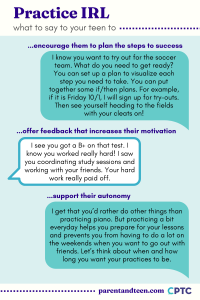
What is more effective is visualizing the steps you need to take to get where you want to go. Instead of visualizing yourself running across the finish line for the 10K race, visualize yourself getting up in the morning, putting on your running shoes, and getting out at 7:00 am to do a five mile run to get in shape. The more specific you can get about visualizing yourself doing things, the better.
Another effective strategy is planning for how you’re going to go about things. We call these “if / then” statements. You say, “If it’s 6:00 pm at night, then I’m going to study for one hour.” What happens is you take away the guesswork from, “If it’s 6:00 pm at night, should I study?” You’ve made a plan. It’s 6:00 pm. You’re going to study.
EP: It’s common to hear adults tell young people that they are smart or talented when they do well in hopes of increasing their motivation in an area. But what can a habit of telling kids they’re smart or talented do to the teen mindset? And what can we say instead?
WG: It seems so counterintuitive that we don’t want to tell people they’re smart or talented when they do something well, because everybody likes to hear that they’re smart or talented. The problem is that when we tell people they are smart after they do well, they attribute doing well to that. “The reason that I did well on that exam is because I’m smart.” or “The reason I got a goal during soccer is because I’m a natural at soccer.” But we all inevitably hit some setbacks where we don’t do well. We get a bad exam grade or we have a bad game. If you attributed your success to some innate – or inherent – quality, you will make the attribution that you failed because of that same quality. “I guess I’m not as smart as I thought I was.” or “Actually, I’m not a natural soccer player after all.” Your motivation can really plunge after that.
We can still give people positive feedback and we can still appreciate our teens for what they’re doing, but what we want to do is to encourage a different kind of attribution in our praise. Instead of commenting on how smart or talented they are after they’ve done well, praise the effort they put in and the strategies they used to solve problems. We can say, “Wow, you got a B+ on that test. I know you worked really hard. I saw you studying, and I saw you planning to study and working with your friend, and that really paid off.” Give them praise for the strategies they use and for the effort they put in. Then, when they don’t do so well, what do they say to themselves? They say, “Well, I didn’t score during the game. But I can try harder by getting more sleep the night before. And I can practice harder next week.” They know there are things they can do about effort and strategy. You’re giving your teen a positive message when you praise them for strategies or the effort that they put in.
We all want to be the best motivators for our kids, and we want to be the best cheerleaders for them as well.
Save this graphic or pin it for later to practice these concepts IRL (in real life):
Also Read This
Related topics for helpful discussions.